SeMA-프로젝트 A
23년의 서울시립 미술아카이브의 개관 프로젝트의 연장선상에서, 미술아카이브의 내부와 외부를 연결하는 옥상정원과 유휴공간을 무대로 하여 소장품과 신작 커미션을 함께 배치하여 내부와 외부, 소장과 창작을 연결한다. 공간을 새로운 관점에서 해석하고 작품과 공간의 관계를 지속적으로 재고하고 사유한다.
2026 SeMA-프로젝트 A
2026년 SeMA-프로젝트 A는 서울시립미술관 2026년 기관 ·전시 의제인 ‘창작’, ‘기술’을 주요 화두로 삼아, 동시대 예술에서 창작이 발생하는 조건, 그리고 산업화, 기술화가 어떻게 일상의 감각과 창작의 방식을 재조직하는지를 공간적, 조각적 실천을 통해 질문하고자 한다. 여기서 ‘기술’은 테크놀로지에 국한되지 않으며, 산업화나 도시화를 구성하는 인프라, 기술적 환경을 지지하는 체계와 물질적 기반 등을 포괄하는 개념으로 이해된다. 즉, 우리가 일상적으로 인식하지 못한 채 통과하는 층위가 어떻게 공간과 삶을 조직하고 있는지를 드러내는 데 초점을 둔다.
이러한 인식은 미술아카이브의 옥상정원과 유휴공간이라는 장소성이 지닌 지닌 ‘보이는 공간’과 ‘보이지 않는 구조’의 대비와도 연결된다. 기록을 영구히 보존하는 제도적 공간 위에 놓인 이 외부 공간은 제도와 일상이 교차하는 지점이며 깊숙이 자리한 체계가 표면으로 드러날 수 있는 가능성의 장소이기도 하다. 2026년 프로젝트는 이 경계적 장소에서 기술의 표면 아래의 역학을 사유해보고자 한다.
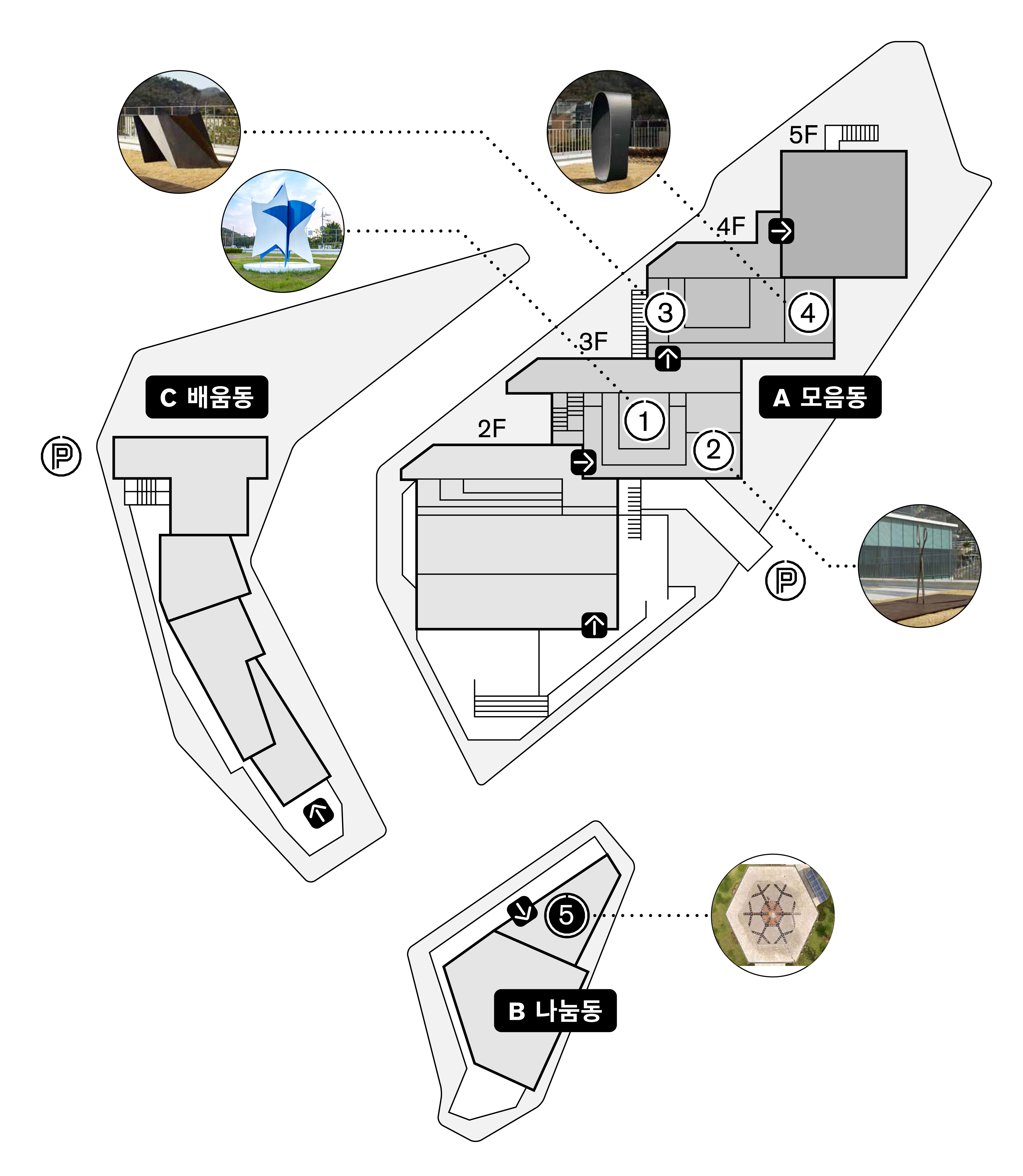
김인겸, 〈빈 공간〉, 2006, 스테인리스 스틸에 우레탄 도장, 190×113×55cm
〈빈 공간〉은 평면과 입체 사이를 오가는 일종의 착시 효과를 불러일으키면서 작품의 물리적인 현존과 그것이 놓인 공간 사이에 무한한 공간을 보여주는 작품입니다. 김인겸 작가는 전통적인 조각의 볼륨과 매스에서 완전히 벗어나 스테인리스스틸을 주재료로 한 ‘면’의 조형을 통해 공간의 점유가 아닌 ‘비어있음’을 제시합니다.
이원우, 〈Dancing Star(별별하늘)〉, 2025, 스테인리스 스틸에 우레탄 도장, 180×150×150cm(좌대 지름 160cm, 높이 10cm)
이원우는 설치, 조각, 퍼포먼스, 영상 등 다양한 매체를 통해 삶의 단편을 재치 있게 환기하는 상황을 연출하며, 익숙한 현실에 균열을 냅니다. 미래가 불확실한 우리 세대가 느끼는 불안에서 벗어나기 위해 작가는 클로버, 하트, 별과 같은 행운의 상징을 불러들이고 춤을 추는 등 위트와 유머, 아이러니를 동반하는 작업을 진행합니다. 〈Dancing Star〉는 평창동의 산세와 조화를 이루고 있는 서울시립 미술아카이브의 옥상정원에 설치되어, 주변 환경을 환기하고 관람객에게 함께 춤추는 상상을 건넵니다. 이 작품은 종이를 자르거나 접어서 노는 아이들의 색종이 놀이에서 영감을 받아 제작된 연작 중 하나입니다. 앞뒤의 색이 다른 세 개의 별이 서로 등을 맞대고 어울려 춤추는 형상은 경쾌한 움직임과 산뜻한 색감의 대비를 통해 시각적 리듬감을 자아냅니다.
최성록, 〈A Man with a Flying Camera〉, 2015, 단채널 비디오, 컬러, 무음, 7분 2초
최성록은 디지털 매체를 매개로 기술 환경의 변화가 동시대의 풍경과 사건을 어떻게 재편하는지 탐구합니다. 작품 〈A Man with a Flying Camera〉는 드론의 카메라가 포착한 몽타주를 통해, 부유하는 시선에 포착된 인간의 모습을 마치 '움직이는 픽셀'처럼 그려냅니다. 이는 관찰자의 감각과 마찰을 일으키는 기계적 시각과 그 고유한 시간성을 드러내며, 인간 중심적 시점에서 벗어난 새로운 관조의 영역을 제시합니다.
홍명섭, 〈De-veloping-Silhouette Casting〉, 1984-2010, 철판에 워터제트 커팅, 투명 우레탄 도장, 200×200×400cm
〈De-veloping-Silhouette Casting〉은 철판을 가위의 실루엣(Silhouette)대로 커팅하여 이를 수직으로 세운 작품입니다. 가위라는 독립된 형상(존재)인 동시에 철판을 오려낸 흔적(부재)으로서 이미지와 일루전의 경계에 있는 이 작품은 사물을 고정된 인식으로부터 해방시키며, 해체의 미학을 구현합니다.
홍석호, 〈철판 접기〉, 2000, 철판 용접, 절곡, 148×258×67cm
〈철판 접기〉는 철판의 재료적 특성을 최대한 수용하면서, 작가 자신의 의도적인 제작 행위는 최소화하는 조형적 실험을 보여주는 작품입니다. 홍석호 작가는 공존이 불가능하다고 여겨지지만, 긴 시간과 과정을 거쳐 마침내 공존하게 되는 대상과 관계들 안에서 나름의 가치를 찾고자 했습니다.
촬영: 홍철기
SeMA-Project A
SeMA-Project A takes the rooftop garden and adjacent unused spaces—connecting the interior and exterior of the Art Archives—as its primary stage. By placing collection works alongside newly commissioned pieces, the project brings together inside and outside, collection and creation. It seeks to reinterpret the space from new perspectives and to continuously reconsider and reflect on the relationship between artwork and site.
2026 SeMA-Project A
The 2026 edition of SeMA Project A takes as its central themes the Seoul Museum of Art’s institutional and exhibition agenda for 2026—“Creation” and “Technology.” The project explores the conditions under which artistic creation emerges today, and questions how industrialization and technologization reorganize everyday perception and modes of making. Here, “technology” is not limited to digital or advanced media, but is understood as an expanded concept encompassing infrastructure, industrial systems, and the material and structural foundations that support the technological environment of urban life. The project focuses on revealing how these often-unnoticed layers organize both space and lived experience.
This perspective is closely connected to the spatial condition of the Art Archives’ rooftop garden and unused areas, where the contrast between visible space and hidden structures becomes particularly pronounced. Situated above an institutional space dedicated to permanent preservation, these exterior zones form a threshold where system and everyday life intersect, and where deeply embedded structures may surface. The 2026 project engages this liminal site to reflect on the dynamics that operate beneath the surface of technology.
Kim Inkyum, 〈Emptiness〉, 2006, 190×113×55cm, Urethane painting on stainless steel
Eliciting an optical illusion effect of alternating between two and three dimensions, Emptiness shows the infinite space that exists between the physical presence of the artwork and the setting in which it is placed. Artist Kim Inkyum leaves the volume and mass of the traditional sculpture behind completely, using the shaping of surfaces in stainless steel to present “emptiness” rather than the occupying of space.
Wonwoo Lee, 〈Dancing Star〉, 2025, 180×150×150cm(Plinth: Ø160cm, H10cm), Stainless steel, urethane painting
Through various mediums including installations, sculptures, performances, and videos, Wonwoo Lee presents scenes that whimsically evoke the fragments of life, creating fissures in familiar realities. By summoning symbols of luck―clover, heart, and star―to navigate the anxiety of our generation's unforeseen futures, the artist presents an installation in which the stars themselves appear to dance, infused with wit, humor, and irony. In Dancing Star, the artist places the stars in the garden to enliven the surroundings and invites audiences to dance around them at the Rooftop of Art Archives SeMA, a space that shares the mountain terrain with the Pyeongchang-dong neighborhood. Derived from the childhood activity of origami―cutting and folding papers―this work, part of a series, features three distinct stars with different colors on the front and back. Stars dancing together, back-to-back, evoke visual rhythms with their vivacious movements and contrasting hues.
Sung Rok Choi, 〈A Man with a Flying Camera〉, 2015, single-channel video, color, silent, 7 min 2 sec
Investigating the impact of the digital medium on the reconfiguration of contemporary landscapes, Sung Rok Choi examines how technological shifts reshape our environment. In A Man with a Flying Camera, a montage of drone perspectives portrays human figures as mere "moving pixels" adrift in a floating gaze. By exposing a mechanical vision and a unique temporality that grate against human senses, the work opens up a field of contemplation detached from the conventional human-centered viewpoint.
Hong, Myung Seop, 〈De-veloping-Silhouette Casting〉, 1984-2010, 200×200×400cm, Water jet cutting on iron plate, Urethane painting
For De-veloping-Silhouette Casting, an iron plate has been cut along a silhouette of scissors and raised upright. Existing at the boundary between image and illusion as both the independent shape (presence) of the scissors and the evidence (absence) of the iron plate’s trimming, the work embodies an aesthetic of deconstruction as it liberates the object from fixed perceptions.
Hong, Seok Ho, 〈An iron plate fold〉, 2000, 148×258×67cm, Iron plate welding and bending
Incorporating the characteristics of its iron plate materials, An Iron Plate Fold illustrates the aesthetic experiment of an artist who is seeking to minimize his own activities of deliberate “creation.” Artist Hong Suk-ho has attempted to discover the values within the relationships among objects whose coexistence may be seen as impossible that eventually come to coexist over time and lengthy processes.
Photo: HONG Cheolki
